10 January 2012

Kalimantan

Nat: We had quite a few visitors in December including Candice's brother Brenton and my sister Tabitha. Tabitha wanted to do some travel with us so on the 17th of December 2011, just before Christmas we flew to East Kalimantan in the Indonesian part of Borneo to explore the famous River Mahakam. It was weird being so close yet so far from Sabah. I had thought about visiting Kalimantan for years but land travel from Sabah is virtually impossible due to dense jungle.

Tabitha and I on our trusty boat on the Mahakam

We pre-arranged a guide, Pak Rustam and spent the first night in Samarinda at his home. That was a lovely experience although Samarinda itself is nothing special.


Coal is what keeps Samarinda in business. These conveyors loading barges dot the riverside near the city.

Just because I don’t want to forget all the places we went, I’m going to briefly list out the places on our trip which to my recollection went something like this:

Day 1 – Balikpapan to Samarinda.
Day 2 – Samarinda to Kota Bangun by road. We then got in our boat and took the Mahakam River to the Kahala River to Lake Semayang to the Berinding River to Muara Muntai where we spent the night.
Day 3 - We took the Mahakam River to Lake Jempang via a village called Jantu to the Ohong River via Muara Ohong. We had lunch at Mancong, a Dayak Benuak village and then doubled back around to the lake and then stayed in a longhouse at Tanjung Isuy
Day 4 – We went via the Baruh river to Muara Pahu for lunch and then briefly down the Pahu River. We spent the night in Muara Muntai again.
Day 5- We made our way back to Kota Bangun, got back in the car and headed back to Samarinda. We hired a car and went to Balikpapan where we spent our last night
Day 6 – Balikpapan and bye-bye Kalimantan.

Phew! We went through so many cities, villages, towns, lakes and rivers that I knew I decided to document their names. The trip was amazing and we saw heaps of wildlife including snakes, macaques, proboscis monkeys, otters (known as barang-barang locally), cranes, big stalk-like birds called tung-tungs, buffalo and lizards, especially on days 3 and 4. The only downside was that we missed out on seeing freshwater dolphins.


A proboscis monkey leaps from one tree to the next


Pushing through the reeds on Lake Jempang


Sunset on the Mahakam


Jempang village on the water

Our nights in Muara Muntai and Tanjung Isuy were great. Muara Muntai had raised streets made of wood as it sits partially over the river and is prone to flooding. The people were friendly and the kids adorable. Being made up mainly of Banjar Malays, Muara Muntai was Muslim. Tanjung Isuy on the other hand was Dayak and so they were Christian.


The wooden streets of Muara Muntai


Benuak headdress in the long house we stayed at in Tanjung Isuy


A hole in the floor of a floating hut is toilet, shower and sink all rolled into one for the people on the Mahakam and Ohong rivers. Fish circle the hole, waiting to eat your poo.


At Tanjung Isuy

A big thank you to our guide, Pak Rustam who also leads cross-Borneo treks that take 20 days. I’ve decided that one day I’ll do one of those. Rustam is recommended by the Lonely Planet and his email address is rustam_kalimantan@yahoo.co.id and phone number is 0541 735641 if anyone’s interested.


Our guide Rustam beat me in a hard-fought battle of chess in Muara Muntai. Indonesians are crazy about chess.


Candice falls in love with the locals at Muara Muntai

We spent our last night in Balikpapan in a hotel. It was weird to be back in civilization, although it also meant the pollution was more evident. Minus the cities, East Kalimantan was beautiful, the only downside was the pollution in villages and towns. Sanitation and health education is a big problem – as we found out directly. All three of us fell really ill with bacterial infections. We ended up with the runs for nearly a month.


Our hotel in Balikpapan advertised itself as having a "beach view". This was the view.


The view from our hotel


15 December 2011

Work trip to Bengkulu


Being part of the Public Participation Subdivision, it was all hands on deck for the annual “16 Days of Activism against Gender Violence” campaign which ran from November to December. Part of the campaign included Komnas Perempuan supporting regional events held by partner organisations around the country. I (Nat) was fortunate enough to accompany one of the commissioners (Neng Dara) to the province of Bengkulu in Sumatra from 24 to 27 November 2011.


Arrival at the Bengkulu airport


The house in Kota Bengkulu in which Sukarno was placed under restricted residence 1938-1942


Although a large city, the streets of Kota Bengkulu are relatively quiet

We got straight into it as soon as we landed in the capital city (also called Bengkulu or Kota Bengkulu) on the Thursday with a media audience with local print and television media, our faces featured in the next day’s paper. Our hosts, Cahaya Perempuan Women’s Crisis Centre were gracious enough to drive us around and made life easy.


Sunset on Pantai Panjang

Friday morning saw us attending a public dialogue with civil servants and important government officials who in my view demonstrated a shallow understanding of human rights. There was even an outspoken professor who called it “violence against men” when women wear skimpy clothes because it makes it difficult for men to “resist”.

Being the only “white” person there was like being a celebrity. Even though I was there to assist Neng Dara, everyone wanted photos with me. I even got my name mentioned in the VIP greetings they do at the beginning of speeches.


The clean mountain air of Curup

That afternoon we packed up and made our way to Curup the more rural regency of Rejang Lebong. Driving up into the mountains along windy roads really reminded me of going to Tambunan in Sabah – it was strangely familiar yet unfamiliar. Curop is quite high above sea level and I was looking forward to a more temperate clime. Once there we went straight to Bupati’s (regent) official residence. It was a palatial mansion that was probably unnecessary for the equivalent of a rural mayor. We were greeted in the official reception hall and I was seated next to the man himself. Somehow they had got wind that an Australian was coming and so they had prepared two interpreters! Being some of the few people who could speak English in town, they turned out to be local high school students. I felt that I had let them down when they realised I spoke fluent Indonesian. I also felt awkward that I was receiving so much unwarranted attention. Following food and drink and general chit chat to my added suprise I discovered that Neng Dara, an important lady who was the former head of Cahaya Perempuan and myself would actually staying in the “palace” as VIPs that night. Everyone else had to stay in a hotel. Somehow I also found myself in a suite of sorts. I had my own private lounge room, four-posted bed and spa. Typical of Indonesia I didn’t have a sink or toilet paper though. By some stroke of further weirdness, the other VIP lady who was a founder of Cahaya Perempuan used to live in this house 6 years ago when her husband was randomly bupati of this regency! She still knew some of the servants by name and told me that my room was where they used to house visiting governors and other big shots. Wow the things you get for being a white person.


With my 'translators' at the Bupati's residence in Curup


In true Indonesian style, the spa in my suite in the Bupati's residence had been turned into a water container

The next day’s event went quite well. I’m beginning to understand though that Indonesian officials will generally open an event but do not stay for it. As soon as the bupati gave his speech, the prayer was read and he left. Half the other officials in the audience walked out with him, leaving lower-ranking officials and government servants (mostly women) to remain.


At the public dialogue in Curup


Overall despite the unwarranted attention, it was a great experience. By starting my days early, I managed to squeeze in quite a bit of sightseeing and I made some great friends. Bengkulu is interesting as despite being beautiful (and far cleaner than most of Java), is not really a tourist destination. The province was a former British colony until 1824 when it was traded to the Dutch for Malacca (and Singapore). Bengkulu still has the marvellously preserved Fort Marlborough which I visited and stunning beaches. I also made it to the Suban hot springs while in the mountains. Though apparently the capital has a population nearing 1 million people, there are few high-rise buildings and shopping centres, giving it the rural feel of a small town that’s just very spread out. I didn’t encounter any fast food outlets and roads were basic at best. It was refreshing to breath the unpolluted air!


The waterfall at Suban


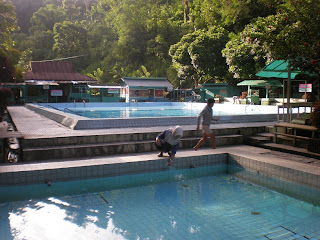
The heated pool at the Suban hotsprings was empty at 6am


Fort Marlborough in Kota Bengkulu


24 November 2011

Indonesia v Malaysia soccer

An experience like no other is to watch an Indonesian soccer match. Many of my work colleagues warned me not to go as they can frequently turn dangerous but we threw caution to the wind and went to see Indonesia v Malaysia for the final group match of the SEA Games soccer tournament at the ageing Gelora Bung Karno Stadium.


Indonesia considers Malaysia its biggest rival in everything it does, particularly in sport. Strangely, this is largely a one-way thing as most Malaysians are unaware of this rivalry, more often measuring themselves against benchmarks set by Singapore. Nevertheless, this soccer match was set to be a dazzler and given our Sabahan links we couldn’t miss it.

Indonesians are fanatical about their national team and these emotions are amplified tenfold when up against Malaysia in soccer or badminton. Over 100,000 people squeezed into the 85,000-capacity stadium which meant that in the event of an emergency we were done for. The crowds rushed the ticket gates and officials were unable to control the stampede. We later learnt that 2 people died that night.


View of the crowd at one of the gates as they rush the turnstiles

The atmosphere was electric but I was disappointed at how disrespectful the crowd was towards the visiting team, booing during the Malaysian national anthem and chanting obscenities the whole game. Nevertheless Malaysia won the game 1-0 silencing the crowd. The two teams later met again in the final which was also won by Malaysia.

At least we can say we survived an Indonesian soccer match!


The crowd atmosphere before the game

16 November 2011

Candice starts work at Sahabat Anak

I began work on the 30th of September 2011. After 4 months acting as a lady of leisure house wife I was really looking forward to getting back into full time work. Life had been pretty sweet lying by the pool, catching up with people for lunch and going to the salon for cream baths (a wonderful Indonesian head massage/hair masque). Only problem was I really didn’t have enough friends who also had nothing to do in the day time…so I started to get a little bored.

AVI has helped me find a position with an organisation called Sahabat Anak. They work with street children in Jakarta and focus on education and advocating for children’s rights. Before we came here I knew I wanted to work with an organisation that cared for the urban poor in Jakarta. Jakarta is a tough place to live and although it is a city full of millionaires, it is also a city full of people who can’t even scrape together enough for one meal a day. Children are particularly vulnerable in this environment. Frequently they do not attend school as they have to beg, busk or sell bits and bobs on the streets. They either earn money to feed themselves or to support their families. Frequently they experience physical and sexual abuse from private citizens but also from authorities as well. They are susceptible to becoming prostitutes or even being trafficked as sex slaves. Sahabat Anak is working hard to form friendships with as many street children as possible. Through developing friendships with the children they are able to provide quality programs that suit their needs such as educational, nutritional and health programs. Sahabat Anak aims to get children back into formal education and help these children dream of a bigger and brighter future. Already 15 of the children Sahabat Anak has worked with have continued onto university despite all the obstacles it takes to get them there.

My job title is Public Relations Advisor and consists of a whole array of things. Mostly I am looking into their social media networks and developing a blog for them while also improving their website. The internet is the biggest form of communication in this day and age and most foreigners who come to Jakarta hear about Sahabat Anak via the web in some shape or form. However, I really have no idea how to do all this, so thank God for YouTube tutorials. I am also working together with the Sahabat Anak team to develop a survey in order to collect data on the children that they work with.


While all this is going on I am also helping organize a fun run for the 18th of December in conjunction with The Jakarta Globe (a local English newspaper here). We also have a campaign which will run next year with The Jakarta Globe and Starbucks which I am also a part of.

There is certainly a lot going on. Our office is being renovated, so we are working in a construction site, and we also share our office with one of Sahabat Anak’s projects with is the Children’s Activity Centre – an informal school for street teens who are unable to access formal education. The kids are great though and are helping me learn more and more Indonesian. Although most of the time I have no idea what they are saying. I have loved the whole experience so far. And I am keen for next year and all the new projects I will be working on!

15 November 2011

Jakarta weekend escapes

Life in Jakarta can be tough if you don’t get out now and then. The good thing is there are plenty of awesome weekend trips to do to escape the Big Durian. And yes it does occasionally smell like one. Krakatoa in our last post was one of the many we’ve done this year. Here are a few more we’ve managed to squeeze in over the last couple of months

Grand Final Weekend in KL (Candice: 29 Sept, Nat: 30 Sept – 2 Oct)

Although Candice left a couple of days earlier, this really was a weekend trip for me. Kuala Lumpur is only a couple of hours flight from Jakarta and is a welcome distraction every now and then for some good food. Although I have never really liked KL, it’s so much cleaner than Jakarta it almost feels like being in Singapore! We decided to catch up with some friends to watch the AFL Grand Final at a pub, an event hosted by the Malaysian Warriors Australian Rules Football Club. Thankfully much to the delight of everyone assembled Geelong thrashed Collingwood.

Bandung (29-30 Oct)


Asia-Afrika Street in Bandung

We’d been talking about going to Bandung for ages but kept putting it off. There’s an executive shuttle bus that leaves from almost right outside our front door and so one day we just booked tickets and went for the weekend. Leaving on the Saturday morning at 5.15am after a long dose of karaoke the night before probably didn’t help but at least we got two full days to play around with.


Bandung's art-deco buildings have seen better days

Bandung is the fashion capital of Indonesia and attracts hordes of local and international tourists for it’s “cheap” shopping. We couldn’t really see what all the fuss was about as the prices weren’t that low. The city has its drawcards but apart from some art deco buildings in the city and the shopping, there aren’t many places of interest and the museums are mediocre. Thankfully the day trips outside Bandung are amazing. We were able to get public transport to Tangkuban Prahu volcano and back. It took up a whole day but was worth it. There weren’t a whole lot of non-Indonesian tourists there which meant the souvenirs were tacky. It was colder than Bandung but not cold enough for fur coats and hats!


Candice at one of Tangkuban Prahu's active craters


The hotsprings


The eerie mountain mist and foliage made it look like something from LOTR


Waste not, want not. We'll just have to use it again.

Pulau Tidung (12-13 Nov)


Having already been to Tiger Island (Pulau Macan) with our expat friends earlier this year, it was time to try an Indonesian equivalent in the Seribu Islands. Pulau Tidung was about a tenth of the price and we managed to squeeze in a weekend trip with some of my Komnas Perempuan workmates.

Getting on the boat at Muara Anke


Children on the narrow streets of Tidung

It was a truly Indonesian experience and while we had a great time I don’t recommend Westerners come here if you’re not prepared to forego certain comforts you may be accustomed to. The electricity on the island had been out for almost a month but the tour agent hadn’t bothered to tell us that our ‘air-conditioned’ accommodation would actually be an oven.
There are about 2000 people who live on the small island and motorcycles are everywhere; no cars though as the laneways are too narrow. The island is probably only 50 metres wide but is a few kilometres in length. Technically it comprises two islands joined by a man-made bridge – and it’s definitely worth a weekend exploration.


Candice and Andy on the way to snorkelling


Sunset

Baduy (18-20 Nov)

The Baduy people are a small indigenous community that live only about 170kms from Jakarta in Banten. Ethnically and linguistically Sundanese, the Baduy have lived in relative isolation for at least 400 years. They are accorded a special status by the Indonesian government and live in a large forest reserve. The Baduy shun modern technology such as electricity and machinery. They are culturally forbidden to use modern vehicles and must walk barefoot everywhere. Often they will walk for days to cities like Bandung and Jakarta to sell their wares.


The Baduy village we stayed in

The population of less than 10,000 people are separated into two clans: the Inner Baduy (Baduy Dalam) and the Outer Baduy (Baduy Luar). The Outer Baduy villages form a ring around the Inner Baduy villages and are tasked with protecting the latter from outside influence and visitors. The Inner Baduy only wear white or black traditional cloth and safeguarding Baduy culture, rituals and sacred sites. The Outer Baduy on the other hand usually wear blue or black traditional dress. It was common to see young Outer Baduy males wearing modern dress – some even had Blackberries (who knows how they charge them without electricity). Some live on the fringes and are permitted to use vehicles. School is forbidden for all Baduy and very few can speak Indonesian.


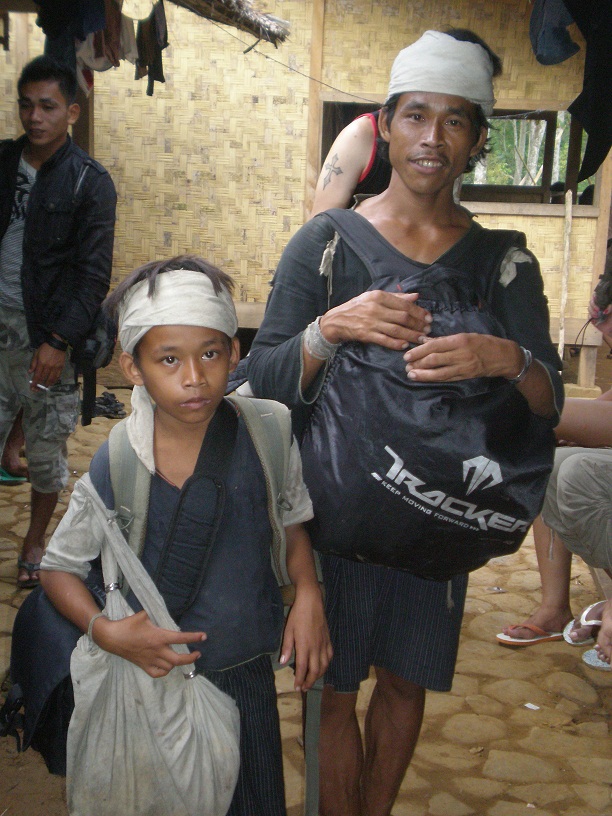
An inner Baduy father and son acting as porters


Some of our group pose as Baduy women walk by


The river which is the source of everything

We were privileged to be able to visit the Outer Baduy for a weekend with a cool travel group we’ve discovered called Road Less Travelled. We stayed in an Outer Baduy village but unfortunately non-Indonesians (including Indonesian Chinese) are forbidden from visiting the Inner Baduy. We did however meet many Inner Baduy people who travelled through the village we were in.


Anjee and I opening durian of which were not in short supply


The naturally-formed hanging bridge which took 50 years to grow

And no our life isn’t just about travelling but we want to showcase some of the cool weekend trips one can do from Jakarta.

11 November 2011

Krakatoa, an Island Volcano

On the weekend of 17 September 2011 we set out for the famed volcano-island of Krakatoa with Horst, Alice and Farina. Located in the Sunda Straight, Krakatoa is only a few hours away from Jakarta.


The boat ride

The volcano achieved infamy in 1883 when it erupted killing approximately 40,000 people and affecting the world’s weather and skies for the next 3 years. Extraordinary sunsets and skies could be seen as far away as Northern Europe. The eruption was so great that it blew the whole island apart, leaving nothing in the middle but sea. Decades later in 1927, an island began to emerge from the sea in place of the old crater and it was aptly named Anak Krakatau (Child of Krakatoa). This newer addition now forms the centrepiece of the Krakatoa islands and regularly erupts. Other than lizards, birds and insects, the island is uninhabited and still highly volatile.


Krakatoa

After a 1 ½ hour boat ride, we spent time snorkelling around Rakata Island and then hanging out on Krakatoa itself. The islands themselves are uninhabited and but the fertile soil ensures quick growth after each eruption. The sand was black. After a barrage of 'crack' jokes, we pitched our tents for the night and proceeded to climb the mountain. The ascent was relatively easy except we were not able to go all the way to the summit as it was too dangerous.


At Rakata


Jetstar jumps on Krakatoa


View of the smoky summit as we climb


Climbing the volcano


View of Rakata Island from the mountain

Krakatoa looms out of the sea like an angry chimney. Lined with sulphur, it looks like it is snow or ice-capped. In fact the higher you climb, the hotter it gets. From the high ground we were able to see the other three islands in the group: Sertung, Panjang and Rakata.


Our guide, "Black" recounted an incident a few months prior when he was climbing the volcano with two French tourists and it suddenly erupted, hurling head-sized boulders down the mountainside. The three of them ran for their lives and thankfully nobody was injured. He predicted the volcano would erupt in approximately two weeks time. Sure enough, two weeks later we read that it was a no-go zone.


Cheesy video evidence that we've been to the Big Krak


Great snorkelling around Krakatoa


Lunch in Carita the next day