(we've been slack and this post was meant to go up in early - mid July)
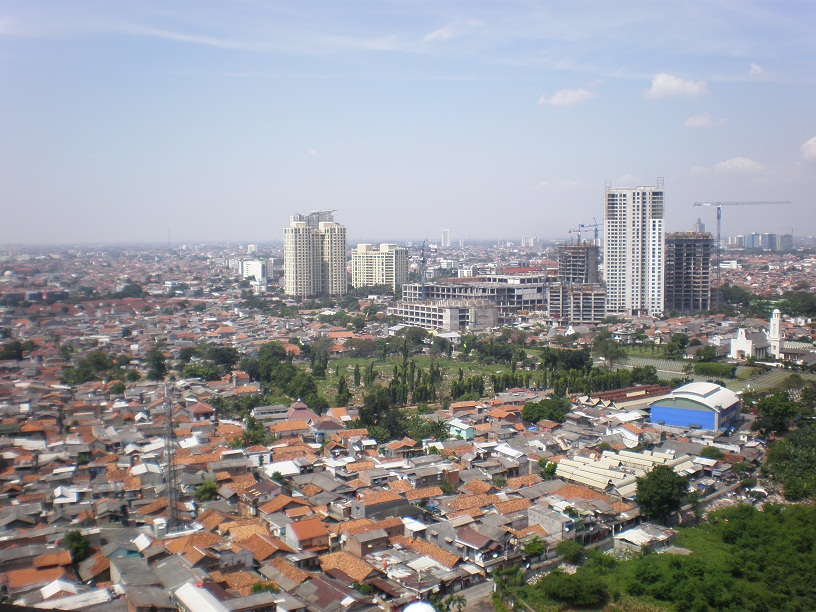
We've now been in Jakarta for the last over a month. In that time Nat has started work at Komnas Perempuan, and we went on a massive accomodation hunt and found an awesome apartment (left) in central Jakarta. We moved in about 4 weeks ago. We are living on the 28th floor so we have a great view of the city. Well at times its a great view when there is a wind that blows away all the smog. On other days like today the view is spoiled by the smog and you can't see very far at all.


The same view from our place on a normal day (top) and a good day (bottom)
Jakarta is an massive city with a greater metropolitan population bigger than Australia's entire population. Traffic is always crazy and taxi drivers will always say macet, which means traffic jam. Everything is so much more expensive in Jakarta then the rest of Indonesia. We could eat a meal for 5000 rupiah in Yogyakarta but in Jakarta its hard to eat for 15,000 rupiah. So many Indonesians move here to earn more money, but prices are pushed up by the extreme wealth that you can also see in Jakarta. While we were looking for a place to rent, we were staying at a hotel in a suburb called Menteng. Menteng is full of massive houses for rich Indonesian politicians and foreign embassies. On the other hand, right near this suburb there is a "river" which is more like a drain it’s so flithy. Undernearth the bridges that cross this river we saw whole families living there. The massive gap between wealthy and poor here is so obvious.

Looking for a place to rent on an 'ojek' or motorcycle taxi
Jakarta does not have many tourist hot spots to offer except for copious amounts of shopping malls. The shopping malls vary from massive malls with rip off hand bags and watches or massive malls with authentic Chanel, Hugo Boss etc. etc. The only thing for Indonesian families to do in Jakarta on weekends is hang out at shopping malls. So we have seen many a wealthy family with their one child and two nannies.  One nanny to mind the child while the other nanny pushes the empty pram. Nannies also have to wear a uniform with nanny written on the side of the arm. These shopping malls are a strange environment where an Indonesian women will happily buy a $17,000 hand bag. And then the minute you step out side you can find children begging on the streets.Many poor people live either on the streets or under any available shelter, such as this bridge located over an open sewer near where Nat works.
Nannies and maids are the norm here. Each apartment that we looked at comes with a place for the maid to sleep. It is a tiny room, think Harry Potter under the stairs type of situation. To have a full time maid who works 7 days a week it costs about $70 for a month. Not much at all. And t he maid will do everything for you, cook, clean, wash clothes and even run errands. One Indonesian woman told me how it is just so difficult having children, you have no time to yourself. This is a lady who has two children, one is 6 years old and the other is 18 months. She has two nannies to look after them, she doesnt work and the 6 year old goes to school on week days. I am not sure what could be difficult about that, sounds like a life of luxury. Maybe its difficult because it would be easy to become bored with nothing to do.

A colourful 'bajaj' or auto-rickshaw which appears to be sponsored by the United Kingdom

The 'economy class' train which is so full that people risk their lives sitting on the roof

Motorcycles, what would you do without one?
Nova and Candice ride a bajajNat:I’m writing this section a couple of weeks after the rest of this post. On the 15th of June 2011, I started my assignment at the National Commission on Violence Against Women (aka Komnas Perempuan). Having never worked professionally outside Australia, my first day was a daunting experience, although after Candice and I were introduced to most of the staff I was told to come back the next day to formally start. This let me catch my breath a bit. I’ve now been there for over a month and I’m quite enjoying it.
Now although Komnas Perempuan’s title appears to confine it to ‘violence’against women, in actual fact it is one of the foremost women’s human rights defenders in Indonesia (and probably the region). The commission was set up under legislation in 1998 after the infamous riots in which ethnic Chinese businesses were destroyed and ethnic Chinese women were raped in various cities around the country. Despite the government connections, it is entirely independent and has been responsible for documenting, reporting and researching various human rights abuses against women around Indonesia, including events as far back as the 1960s. Many of its work and data is used by UN independent experts and it is held in high regard by UN bodies and other international organisations working in the region. Komnas Perempuan also plays a large role in law reform and advocating for legislative changes on discriminatory laws and acts as an intermediary between grassroot activist organisations and the government. My position title is Research Editor and my responsibilities include editing English language publications, international legal research and assisting generally in its English language output and capacity.
Due to my Bahasa Indonesia skills, one of my main duties has become translation of documents and publications into English, which suprisingly I quite enjoy. This last week and a half have been quite busy as we’ve just hosted an international conference on discrimination against women in the context of religion and culture in conjunction with the UN Office of the High Commissioner on Human Rights. I was fortunate to have been involved in helping organise the conference and I’ve met some very interesting and incredible people. Anyway, I’m sure there will be more posts on my job to come!
Candice:
Nat and I are getting into the swing of things living in Jakarta. We even had a house warming the other night with some friends from AVI and others we have met along the way. Two weekends ago we did a day trip to Bogor, a city/suburb nearby with our American friends Leslie, Kate and Amy. It has a massive botanical garden which was quite interesting. Although in true indonesian style there was still rubbish everywhere. However we saw cocoa trees with the cocoa fruit on them and many beautiful orchids. We also made our way to the gong factory in a little industrial side of town. Quite the experience! We are quickly learning that there is no such thing as safety standards here!

The MONAS (Monumen Nasional) also known as Sukarno's last erection
We’ve been trying to use our free time wisely by being proactive and seeing as much of Jakarta and its surroundings as possible. A few weekends ago we went to Old Batavia and Sunda Kelapa, the old port and Dutch colonial side of town which is sadly now falling apart. Buildings built in the 1500s simply lie abandoned and rotting away. Some have been turned into museums but the lack of conservation and hordes of local tourists sitting on antique furniture and touching artifacts will mean they won’t be around for much longer.
Some scenes and videos of Old Batavia and Sunda Kelapa:

Fatahillah Square - this 16th century building is now a museum

Candice and the old Portuguese cannon dubbed 'Si Jaguar' by the locals

Indonesian primary school students love practicing their English and taking photos with white tourists. It gets exhausting but they're really cute.
The old canal

Colonial-era buildings in need of repair

A drawbridge from the 1500s - the oldest in Indonesia

Ironically, this monument was erected in 1996 to commemorate the efforts of preserving the old town. Look at it now.

Children play soccer in Sunda Kelapa amongst the rubbish
View from the old Dutch tower into the slums