31 July 2011

Life in Jakarta

(we've been slack and this post was meant to go up in early - mid July)
We've now been in Jakarta for the last over a month. In that time Nat has started work at Komnas Perempuan, and we went on a massive accomodation hunt and found an awesome apartment (left) in central Jakarta. We moved in about 4 weeks ago. We are living on the 28th floor so we have a great view of the city. Well at times its a great view when there is a wind that blows away all the smog. On other days like today the view is spoiled by the smog and you can't see very far at all.

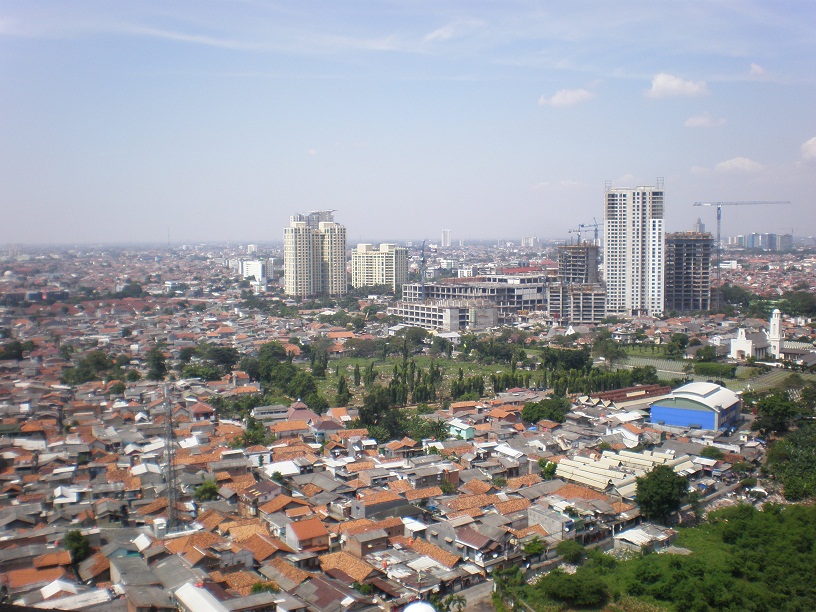


The same view from our place on a normal day (top) and a good day (bottom)


Jakarta is an massive city with a greater metropolitan population bigger than Australia's entire population. Traffic is always crazy and taxi drivers will always say macet, which means traffic jam. Everything is so much more expensive in Jakarta then the rest of Indonesia. We could eat a meal for 5000 rupiah in Yogyakarta but in Jakarta its hard to eat for 15,000 rupiah. So many Indonesians move here to earn more money, but prices are pushed up by the extreme wealth that you can also see in Jakarta. While we were looking for a place to rent, we were staying at a hotel in a suburb called Menteng. Menteng is full of massive houses for rich Indonesian politicians and foreign embassies. On the other hand, right near this suburb there is a "river" which is more like a drain it’s so flithy. Undernearth the bridges that cross this river we saw whole families living there. The massive gap between wealthy and poor here is so obvious.


Looking for a place to rent on an 'ojek' or motorcycle taxi

Jakarta does not have many tourist hot spots to offer except for copious amounts of shopping malls. The shopping malls vary from massive malls with rip off hand bags and watches or massive malls with authentic Chanel, Hugo Boss etc. etc. The only thing for Indonesian families to do in Jakarta on weekends is hang out at shopping malls. So we have seen many a wealthy family with their one child and two nannies. One nanny to mind the child while the other nanny pushes the empty pram. Nannies also have to wear a uniform with nanny written on the side of the arm. These shopping malls are a strange environment where an Indonesian women will happily buy a $17,000 hand bag. And then the minute you step out side you can find children begging on the streets.Many poor people live either on the streets or under any available shelter, such as this bridge located over an open sewer near where Nat works.


Nannies and maids are the norm here. Each apartment that we looked at comes with a place for the maid to sleep. It is a tiny room, think Harry Potter under the stairs type of situation. To have a full time maid who works 7 days a week it costs about $70 for a month. Not much at all. And the maid will do everything for you, cook, clean, wash clothes and even run errands. One Indonesian woman told me how it is just so difficult having children, you have no time to yourself. This is a lady who has two children, one is 6 years old and the other is 18 months. She has two nannies to look after them, she doesnt work and the 6 year old goes to school on week days. I am not sure what could be difficult about that, sounds like a life of luxury. Maybe its difficult because it would be easy to become bored with nothing to do.


A colourful 'bajaj' or auto-rickshaw which appears to be sponsored by the United Kingdom


The 'economy class' train which is so full that people risk their lives sitting on the roof


Motorcycles, what would you do without one?


Nova and Candice ride a bajaj


Nat:


I’m writing this section a couple of weeks after the rest of this post. On the 15th of June 2011, I started my assignment at the National Commission on Violence Against Women (aka Komnas Perempuan). Having never worked professionally outside Australia, my first day was a daunting experience, although after Candice and I were introduced to most of the staff I was told to come back the next day to formally start. This let me catch my breath a bit. I’ve now been there for over a month and I’m quite enjoying it.


Now although Komnas Perempuan’s title appears to confine it to ‘violence’against women, in actual fact it is one of the foremost women’s human rights defenders in Indonesia (and probably the region). The commission was set up under legislation in 1998 after the infamous riots in which ethnic Chinese businesses were destroyed and ethnic Chinese women were raped in various cities around the country. Despite the government connections, it is entirely independent and has been responsible for documenting, reporting and researching various human rights abuses against women around Indonesia, including events as far back as the 1960s. Many of its work and data is used by UN independent experts and it is held in high regard by UN bodies and other international organisations working in the region. Komnas Perempuan also plays a large role in law reform and advocating for legislative changes on discriminatory laws and acts as an intermediary between grassroot activist organisations and the government. My position title is Research Editor and my responsibilities include editing English language publications, international legal research and assisting generally in its English language output and capacity.


Due to my Bahasa Indonesia skills, one of my main duties has become translation of documents and publications into English, which suprisingly I quite enjoy. This last week and a half have been quite busy as we’ve just hosted an international conference on discrimination against women in the context of religion and culture in conjunction with the UN Office of the High Commissioner on Human Rights. I was fortunate to have been involved in helping organise the conference and I’ve met some very interesting and incredible people. Anyway, I’m sure there will be more posts on my job to come!


Candice:

Nat and I are getting into the swing of things living in Jakarta. We even had a house warming the other night with some friends from AVI and others we have met along the way. Two weekends ago we did a day trip to Bogor, a city/suburb nearby with our American friends Leslie, Kate and Amy. It has a massive botanical garden which was quite interesting. Although in true indonesian style there was still rubbish everywhere. However we saw cocoa trees with the cocoa fruit on them and many beautiful orchids. We also made our way to the gong factory in a little industrial side of town. Quite the experience! We are quickly learning that there is no such thing as safety standards here!


The MONAS (Monumen Nasional) also known as Sukarno's last erection

We’ve been trying to use our free time wisely by being proactive and seeing as much of Jakarta and its surroundings as possible. A few weekends ago we went to Old Batavia and Sunda Kelapa, the old port and Dutch colonial side of town which is sadly now falling apart. Buildings built in the 1500s simply lie abandoned and rotting away. Some have been turned into museums but the lack of conservation and hordes of local tourists sitting on antique furniture and touching artifacts will mean they won’t be around for much longer.


Some scenes and videos of Old Batavia and Sunda Kelapa:


Fatahillah Square - this 16th century building is now a museum


Candice and the old Portuguese cannon dubbed 'Si Jaguar' by the locals


Indonesian primary school students love practicing their English and taking photos with white tourists. It gets exhausting but they're really cute.


The old canal


Colonial-era buildings in need of repair


A drawbridge from the 1500s - the oldest in Indonesia


Ironically, this monument was erected in 1996 to commemorate the efforts of preserving the old town. Look at it now.


Children play soccer in Sunda Kelapa amongst the rubbish


View from the old Dutch tower into the slums

09 June 2011

Last days in Jogjakarta


It’s 10 June 2011 and we’ve been in Jogja now for almost exactly 4 weeks. So far things have been pretty relaxed and we’re not missing anything too much yet except maybe orderly queues. Tomorrow we leave this fascinating city for Jakarta to begin the next phase of our lives. This is our last post for Jogja and we thought we’d cover a few things that we’ve been up to since our first Jogja post.

Streaks of clouds emanate from Mount Merapi over paddy fields in suburban Jogja

Borobudur

After several weeks here we finally managed to visit the famed ancient Buddhist temple of Borobudur on a language school field trip. Built in the 9th century, this relic was abandoned a couple of hundred years later and fell into ruin until it was discovered by Stamford Raffles in the early 1800s. Years of painful restoration have finally returned Borobudur to its former glory and it’s now probably the most famous attraction for visitors to Jogja.


Borobudur scenes

Given I (Nat) had been in dire need of a haircut for some time (which is of course entirely my own fault) I decided it would be for the better if I just bit the bullet and got a buzz cut. Besides, what did I have to lose? Nobody knows me here and it would help with the heat. I asked around for the most economic way to achieve this and here’s what we found: Transportation to place of haircut = free, cost of actual haircut = 50 cents, the experience of getting my head shaved by a random bloke with manual clippers under a big tree on the side of a busy highway while being curiously observed by gawking locals after watching the bloke use exactly the same instruments on a kid before me without cleaning them = priceless.


My 50 cent hair cut


Solo

We try and make every weekend count by seeing as much as we can outside of Jogja. Since the weekend before we had conquered a volcano, we decided to adopt a slightly more chilled approach this time and so last weekend we took the train to Solo, a nearby city. The trip was just over an hour and the train was absolutely packed. We felt it deserved a video.

Where Melbourne has Sydney, Manchester United has Liverpool, Aussie Rules has Rugby League and Alien has Predator, well I guess Jogja has Solo. The two cities share many similarities including their proximity to Merapi, the fact they both have Sultans and their love of batik. History tells us that they’ve had their share of squabbles including the split to the thrown a few centuries ago which resulted in two competing royal households. They both also lay claim to the fact they have the best batik in Indonesia. Jogja seems to have a slightly more relaxed air about it with a booming arts and music scene whereas Solo seems to be a tad more conservative. It was unfortunately also the site of some of the infamous race riots of 1998 during the fall of Suharto when ethnic Chinese were assaulted and murdered, their business and homes burned and their women raped. Apparently gangs of men were marching from Solo to Jogja to do the same but the Sultan of Jogja called on all the citizens to gather in the city and to protect it. Jogja escaped unscathed.

Just like Jogja, Solo (aka Surakarta) has both a sultan and (for want of a better word), a prince (or second in charge royally). The Sultan of Solo lives at the Kraton and the Prince of Solo lives at a separate palace called the Istana Mangkunegaran. It got a good rap in the Lonely Planet so we paid it a visit and were not disappointed. It’s in much better condition than the Kraton in Jogja and way less crowded.


Scenes from Solo

We also visited the markets and paid a visit to a privately owned batik museum called House of Danar Hadi. The collection is amazing and I (Nat) know more about batik and how it is made that I ever thought I would care to know after a tour of that museum. Some of the collection is over 200 years old and it includes extremely rare Dutch Batik which is apparently no longer produced. We weren’t allowed to take any photos but out the back were rows and rows of women waxing and dying the batik. It was a tad sweatshop-esque. Handmade batik is such a labour-intensive process that it would probably be too expensive to produce on a large scale in a Western country.


The hardworking batik makers


Life in Jogja

Indonesians love their karaoke and they have state-of-the-art facilities that cater for it. We’ve been out with language school buddies, teachers and other volunteers several times to exercise our vocal cords at Happy Puppy, an excellent family karaoke centre where you get a spacious private lounge you rent by the hour.

We’ve been enjoying our daily classes at Wisma Bahasa and it’s become somewhat of a routine to go to class in the morning, have lunch, do an activity of some sort and then spend the rest of the afternoon at the nearby swimming pool. We could get used to this! We ride our bikes everywhere and apart from a particularly annoying mechanical problem on a hot day in the middle of traffic, they’ve been awesome!


Above: Life is good in Jogja


Our homestay

The actual language classes at Wisma Bahasa have been great. They are one-on-one and we each have about 5 teaches that rotate throughout the week. Since we’re all at different levels, our courses are really tailored for us individually. I (Nat) generally spend 90% of each class just chatting with the teachers about life and about 10% of the time doing work. I’ve been mainly using the classes to refresh my language skills and identify core differences between Indonesian and Malay. Lately I’ve been looking at articles dealing with women’s rights in Indonesia and discussing other interesting issues with my teachers.


Us at Wisma Bahasa: Candice in class, Nat on bikkie break

Today was our last day of class. Candice and I visited Rifka Annisa, a local NGO that deals with female victims of domestic violence and other women’s advocacy issues. Given my assignment will be with Komnas Perempuan in Jakarta, it was a good introduction to my work in Indonesia. It was a bit sad farewelling our teachers but we’re sure this won’t be the last we see of Jogja!


Our fieldtrip to Rifka Annisa


Farewell to our teachers at Wisma Bahasa


With Pak Sunarto and Bu Ning on our last morning in Jogja


Climbing a volcano - Mt Merapi

Now if there’s one thing that Indonesia definitely has more of than any other country, it’s volcanoes.

Given Yogyakarta's proximity to Mount Merapi, one of the world’s most active volcanoes, we simply couldn’t resist the temptation to try and climb it. So on Friday 27 May 2011, together with Horst and Manuela (a Swiss friend) we set out to do just that.

Standing at 2,968m high, Merapi straddles the border of Central Java and Yogyakarta and has erupted regularly for centuries. It erupted in 2006 killing around 5,000 people and causing hundreds of thousands to be evacuated and only a few months ago multiple eruptions occurred between October and November 2010. Despite the fact that last year’s eruptions were the strongest recorded since the late 1800s, only 353 people were killed due to the government’s preparedness and forced evacuations. Jogja and surrounding towns were covered in ash for two days causing havoc.

Nevertheless we were assured that there had not been much seismic activity since March and it was probably safe to climb. Probably.

We were picked up by a driver at around 10pm and driven for about 2 hours to a village called Selo at the foot of the mountain. Due to its elevation, Selo was quite chilly compared to what we had experienced in Indonesia so far. The ideas was to set off at 1am, climb through the night and reach the high plateau just below the summit at dawn just in time for sunrise.

After arriving in Selo at midnight we drank some tea, rested for an hour and then began climbing with 2 guides, torches and no snacks (worst decision ever!). The climb started off very easy on a sealed road. However, this didn’t last long and we found ourselves scrambling up a very worn and slippery path in the dark. Every so often our guides would check the sulphur levels to make sure it was safe to continue. We were pretty quick moving and made it quite far up the mountain, so the guides suggested we hang out in a cave for a bit while we waited for the sun to rise. It was quite an exhausting climb and every time we took a break, we would cool off very quickly in the cold air so we sat by a fire and warmed ourselves for about half an hour and then started the climb again to the plateau.

We made it to the plateau just in time for an amazing sunrise! We could see all the surrounding villages and volcanos.


Sunrise on Merapi


Some of us on the plateau with the summit in the background

Candice:

After admiring the sunrise there was an option to climb all the way to the summit of the volcano, which virtually means you can see into the mouth of the volcano. I said no way! First of all there was no path, as the recent eruption had destroyed it; this meant that the only way up was to scramble up loose ash and rocks from the last eruption. I did not care about seeing the mouth of the volcano anyway, which I thought was a highly dangerous activity. However everyone else wanted to go so Nat went with them and I went back down the volcano with one of the guides.


On the plateau. Behind Candice is Mount Merbabu in the distance, a dormant volcano.

Now I will let Nat tell you how his climb to the summit went. But this is how it went for me. As I was climbing down the volcano the others were climbing to the summit with the other guides. The other guides continued to radio my guide to update him on the condition of the volcano. Supposedly, if at any point the volcano was too active (thus dangerous) they should turn around. My guide told me “oh the other guides are really tired it’s so hard trying to get up all the loose ash and rocks.” I’m thinking, ok, well I am glad I decided not to climb to the summit. Then my guide said “…oh no…listen to this sound.” He let me listen to his radio, at this point the other guides at the summit were radioing my guide and saying “oh the volcano is making such a strange noise, listen how loud it is, it sounds like a helicopter.” I asked my guide “is that normal, the noise the volcano is making?” He said “no, I’ve never heard it in my 15 years of climbing the volcano! It’s really weird, the guides are scared. I think the volcano is too active and they should not stay long.”

Nat:

After I left Candice I quickly realised that I had made a stupid decision. So far the fact I was wearing Converse Chucks hadn’t been too much of an issue, but as soon as I started the summit ascent I began slipping and sliding in the loose dirt. As I scrambled up the steep incline I was frequently losing my footing as my shoes had virtually no grip. At least Horst and Manuela had runners. There was also another couple climbing with their guide who had proper hiking boots.


Do not ever wear these shoes to climb a dangerous mountain.

As the morning sun began to heat up the rock face, we continued to labour up the slope. At times I would frantically scramble upwards as a foothold gave way and other times I would be using every ounce of whatever rock climbing experience I had not to fall. I wished I had worn gloves as my palms began to get cut from sharp rocks. The further up we got, the more determined we became to reach the top, even though I almost slipped and fell climbing laterally twice. I began to wonder how we would get down.


Climbing to the summit

In hindsight it was an extremely dangerous exercise and the guides should have known better. At times those climbing ahead would dislodge bowling ball sized boulders that would come rolling down the mountain narrowly missing my head. Smoke that stank of sulphur was seeping out of cracks in the rocks.

When we finally reached the summit, we were overjoyed. And boy was it worth it. The view was absolutely spectacular! We were on the rim of the crater which was basically like a wall which we could barely hang on to. The guide told me that the last eruptions had blown away the opposite lip of the crater and we could now see for miles into the distance. Although the lava had cooled into new rock, no one had yet dared set foot into the crater due to poisonous gasses and the fact that the mountain was still unsettled.


Scenes from the summit

The strangest thing of all was the fact that the mountain was roaring. It sounded like a waterfall or something, like it was just about to erupt. Sulphurous smoke was rising into the air and occasionally the wind would whip it into my face. It stank of rotten eggs.


Climbing Mt Merapi

Descending was easier than I thought it would be. We basically slid down the summit, trying to avoid sharp rocks. Given the eruptions had totally altered the landscape, the guide really had no idea where he was going. When we reached the plateau, I offered up a silent prayer that we were all safe. Unfortunately the journey to the summit and back had taken about 2 hours and we still had the rest of the mountain to go. It was a grueling trek down. We finally arrived back in Selo just after noon! All in all, we had been hiking, climbing and walking for over 10 hours through the night with no sleep. And I was filthy.


Descending from the summit


Candice:

So later on when everyone made it down safely, I discovered that in true Indonesian style the guides had never let on to Nat and the others that the noise the volcano was making was abnormal, and that they were scared, and that maybe they should go back (because generally speaking Indonesians don’t like conflict and they are always saving face). So instead they continued on because they didn’t want their clients to be unhappy with what they saw.

Nonetheless, we’re both happy we’ve done it and it was definitely an unforgettable experience!


View of other volcanoes in the distance


Collapse on arrival at Selo